Who gets paid when the car fixes itself?
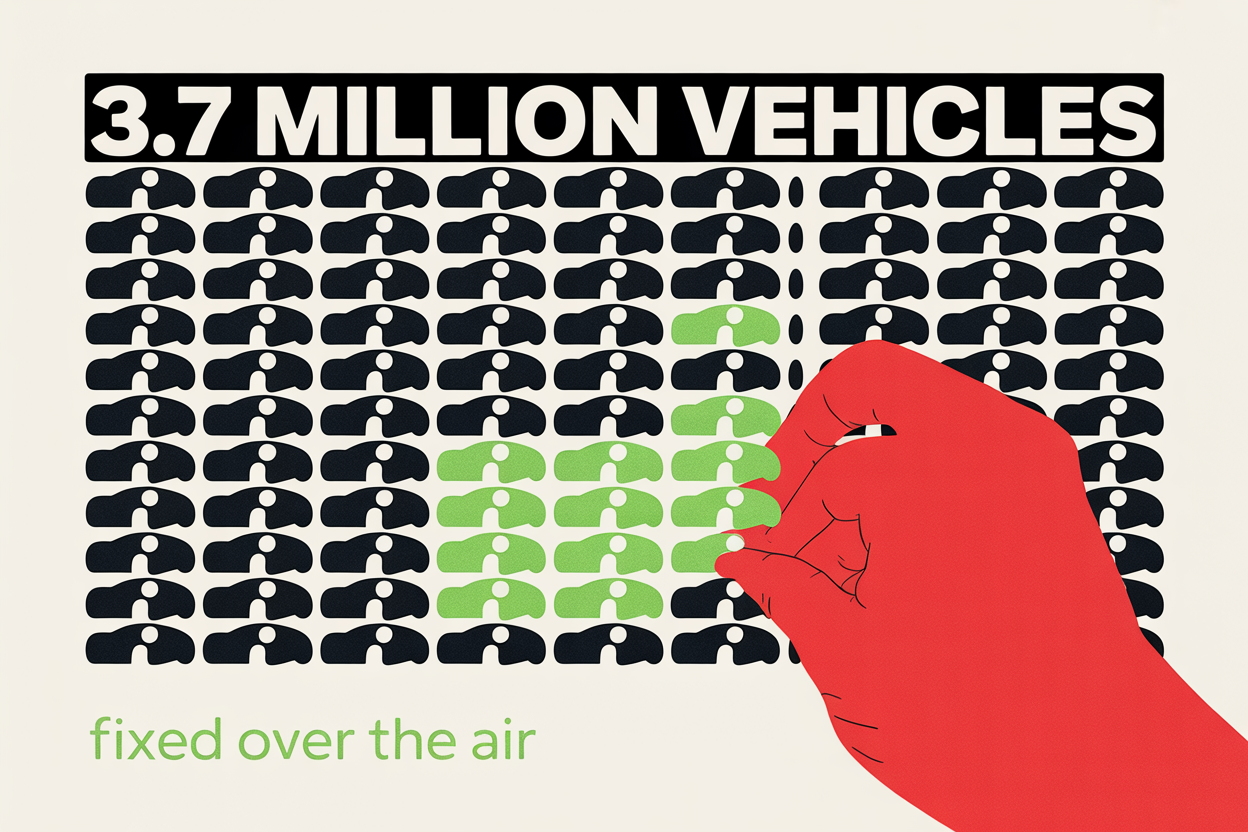
Thirty-five of the 997 safety recalls filed in 2025 were remedied over the air, reaching 3.7 million vehicles. When a vehicle repairs itself overnight, the dealership never opens a repair order, and the contracts that decide who gets paid were written for a technician standing in a bay.
The National Highway Traffic Safety Administration counted 997 safety recalls in 2025, covering 31.3 million vehicles, and 35 of those recalls were remedied partly or entirely by sending software to the vehicle over the internet. Those 35 campaigns reached about 3.7 million vehicles, roughly 12% of everything recalled that year. Four years earlier the same method reached 150,364 vehicles. The work is leaving the service bay quickly enough that federal recall filings already show it.
When a vehicle repairs itself overnight via over-the-air updates, the consequence is that the dealership never opens a repair order. The dealer loses the warranty labor and the parts, and loses the appointment that a recall notice used to create, which is the appointment where a service adviser finds the worn tires and the overdue brake work. While this seamless model delivers undeniable convenience for consumers, it severely disrupts the traditional economics of dealership service departments. For decades, recall campaigns have functioned as a primary engine for customer acquisition; eliminating physical visits removes those opportunities entirely.
Dealers hold roughly 30% of the American service market and have given up 12% of service visits to independent and aftermarket shops since 2018, according to Jim Roche of WarrCloud, who also argues that software, sensors, and driver assistance systems now drive service complexity more than what powers the vehicle. Dealers watching their electric vehicle strategy for the threat to fixed operations are looking past the change in how a repair gets delivered.
Congress looked at this in May and passed on it
On May 21 the House Energy and Commerce Committee advanced the Motor Vehicle Modernization Act of 2026 by 48 votes to 1. The bill writes the 2014 and 2015 industry agreements on repair information into law and gives the Federal Trade Commission the authority to enforce them. It leaves out the provision in the REPAIR Act that would have required manufacturers to give vehicle owners and independent shops access to diagnostic, repair, calibration, and recalibration data. Congress took up the question of who gets to repair a software-defined vehicle and answered it by codifying a handshake from 2014.
That answer leaves the question to private contracts that dealers sign themselves. Most franchise agreements and warranty policy manuals were written when a repair meant a vehicle sitting in a bay with a technician beside it, so they are silent on the terms that decide the economics now. Three of those terms are worth naming: which software updates a manufacturer may deliver directly without compensating the dealer, who receives the signal a vehicle sends when a component starts to fail, and what a dealer is owed for warranty work performed remotely on a customer the dealer sold. I have yet to see a franchise agreement that addresses the second one.
The recall figures jump around from one year to the next. Campaigns using remote updates fell 24% in 2025. The vehicles those campaigns reached rose 51% over the same 12 months. One large campaign covering a few million vehicles can move the annual total on its own, which makes any single year a poor guide to the next one. I am not going to predict the shape of the 2026 number. A manufacturer able to close a recall without paying for a bay visit has little reason to pay for one.
Where this goes next
The count in next spring's recall report is the figure to follow. Campaigns using remote updates peaked at 46 in 2024 and came down to 35 last year, while the vehicles those campaigns reached kept climbing the whole time. A year that lifts both numbers together would tell us manufacturers have stopped testing the method on their largest populations and started using it as the default.
No one has yet released data comparing the cost of resolving a recall over the internet to the expense of servicing it in a physical bay. That number exists inside every manufacturer's warranty accounting and none of them have shared it, which is a shame, because it would settle most of the argument about how fast this moves. Until somebody publishes it, the recall filings are the honest measure available.
A second key indicator is the struggle over which party will ultimately control the stream of real-time failure alerts generated by the vehicle. Software already turns a telematics alert into a booked service appointment, with BLiNK AI among the companies selling it, so the technical problem is solved. What remains is a question about who holds that customer relationship, and it is being answered quietly, one manufacturer program at a time.
A technician can spend 2 hours on a calibration that consumes no parts and closes with a software validation. Flat rate pay plans compensate that work by the book time attached to a repair operation that no longer describes what happened in the bay, so the technician doing the most technical work in the shop can finish the week behind the one doing brake jobs. Hiring profiles carry the same lag, since most postings still screen for wrench speed and say nothing about diagnostic ability.
Automakers have laid the groundwork for this transition over the past decade. Dealerships recognizing the shift this autumn remain ahead of the curve.
For the AI-defined vehicle discussion behind these questions, watch the webinar recap. Sources: National Highway Traffic Safety Administration, 2025 Annual Report on Safety Recalls, published March 2026, for recall counts, vehicles affected, and over-the-air remedy figures for 2021 through 2025 (nhtsa.gov); Jim Roche of WarrCloud, writing in Auto Remarketing on February 12, 2026, for dealer share of the service market, the loss of service visits since 2018, and the point about software and driver assistance driving complexity; Autobody News, May 28, 2026, for the Motor Vehicle Modernization Act of 2026 committee vote of 48 to 1 on May 21, what the bill codifies, and which REPAIR Act provisions were excluded; blinkai.com for the description of telematics-triggered service scheduling.
3 ways to go deeper on this topic
- White paper01
Building Towards the AI-Defined Vehicle, the full AMA and Devox Software framework
Download the PDF - Blog02
From SDV to AIDV: Where Agentic AI Works in Automotive Today
Read the field guide - Webinar recap03
Moving Toward the AI-Defined Vehicle
Watch the recording
Want to talk through what over-the-air service means for your fixed operations? The AutoMobility Advisors and Devox Software team can help.
Moving Toward the AI-Defined Vehicle
September 2, 2026 · Online webinarMore from the AMA team.
 Newsletter
Trends in Visual Inspection Technology for Automotive Retailers
Innovations transforming dealership operations and customer experience. AI was everywhere at NADA in Las Vegas, but one area has immediate, direct application to automotive retail: visual inspection.
George Ayres · Feb 12, 2026 Newsletter
How Rolled-In Negative Equity Turns a $680 Payment Into $1,032
Underwater trades, rolled-in balances, and 84-month terms are quietly rebuilding the monthly payment, and the affordability risk now reaches lenders, captives, and dealer groups.
George Ayres · Jul 8, 2026 THOUGHT LEADERSHIP
The Garage Podcast: Software-Defined Vehicles, Embedded Connectivity, and the New OEM-Supplier Deal
The Garage Podcast — recorded live at AutoTech Detroit 2026 Chip Goetzinger
- The Garage Podcast
Jun 2026Watch talk
Talk to us about what you want to accomplish
Schedule 20-minutes with AMA. We will use the time to understand what you are trying to accomplish and how AMA can help.