Moving Toward the AI-Defined Vehicle
Thank you to everyone who joined AutoMobility Advisors and Devox Software for Moving Toward the AI-Defined Vehicle. The discussion examined what it takes to deploy AI responsibly across automotive engineering, manufacturing, supply chain, and vehicle programs — from validating vendor claims to building the data, governance, and human oversight that make measurable results possible.
- What
- Webinar recap · AMA panel discussion with Devox Software
- When
- Recorded Wednesday, September 2, 2026 · 12:00–1:00 PM EDT
- Where
- Online · YouTube recording
Panelists
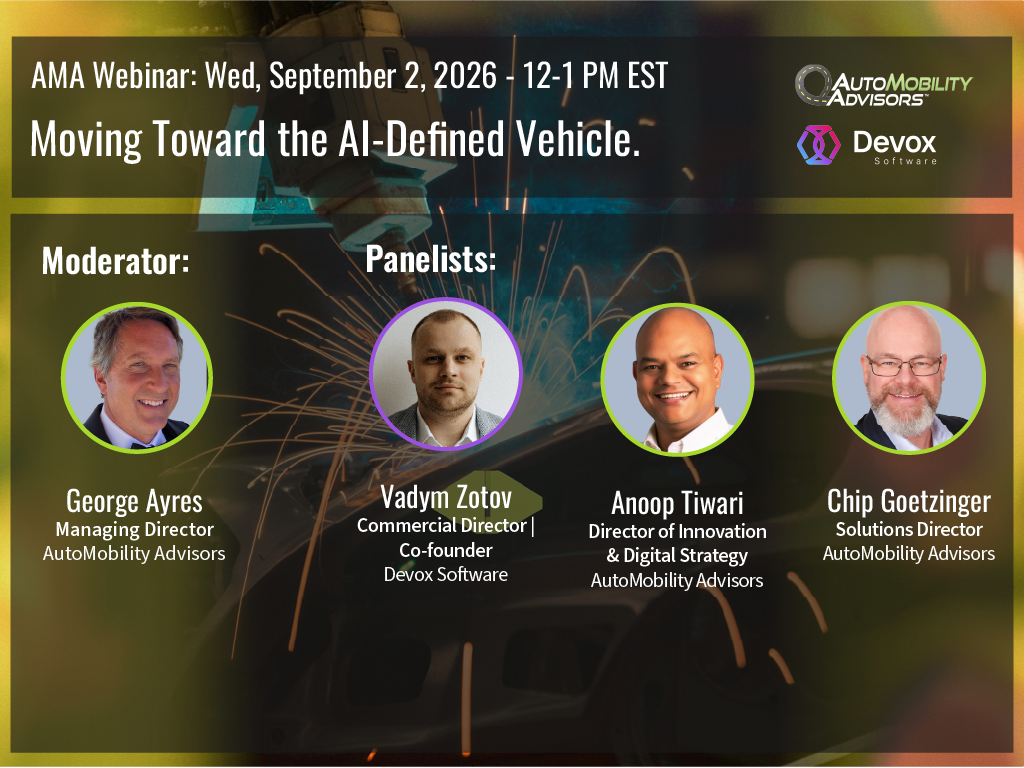
George Ayres, Managing Director at AutoMobility Advisors, moderated the conversation. He was joined by Vadym Zotov, Commercial Director and Co-founder of Devox Software; Anoop Tiwari, Director of Innovation and Digital Strategy at AutoMobility Advisors; and Chip Goetzinger, Solutions Director at AutoMobility Advisors.
What we covered
The conversation opened with a practical reality check: only 13% of companies that describe themselves as AI vendors are delivering genuine AI capability. The panel outlined how teams can test those claims by asking where a system sits on the autonomy ladder, which decision phase it supports, and whether it can make autonomous decisions within clearly defined limits.
The discussion then moved across the automotive value chain. AI can support vehicle design, manufacturing, supply-chain decisions, testing, predictive maintenance, and customer experience, but the strongest early opportunities are bounded workflows with a known signal, a defined response, and a measurable cost of delay.
One example showed engineers cutting test-case preparation time in half with AI, with the greatest gains among less experienced engineers. The productivity gain is only the beginning of the decision: companies still need to decide whether to use the time to reduce headcount, increase scope, or shorten development cycles, while keeping expert review in the loop.
A robust data foundation was a recurring requirement. Legacy systems, inconsistent data, and unclear ownership can prevent an AI project from producing reliable results, especially when a decision crosses manufacturing, service, warranty, or supply-chain systems. The panel also noted that controlled manufacturing environments can offer a more manageable starting point than safety-critical vehicle behavior.
The VERO model — value, execution readiness, risk, and ownership — offered a practical screen for deciding whether an AI project is ready to move forward. That final question matters: outcomes such as warranty cost often span several organizations, so accountability and decision rights need to be explicit before an AI system is given authority.
The session closed on a measured path to adoption: start in a focused domain where risk can be managed and outcomes can be measured, test thoroughly before production, establish checks and balances, and keep human oversight where the consequences require it. AI earns broader authority through demonstrated performance, not through the label attached to the product.
Watch the full recording above or watch the webinar on YouTube.
3 ways to go deeper on this topic
- White paper01
Building Towards the AI-Defined Vehicle
Download the PDF - Blog02
From SDV to AIDV: Where Agentic AI Works in Automotive Today
Read the field guide - Roadmap Newsletter03
Towards the AI-Defined Vehicle: A Framework for Choosing and Scaling an Agentic Use Case
Read the newsletter
Working on an AI roadmap for a vehicle program and want a second read on it?
George Ayres (moderator) with panelists Vadym Zotov, Anoop Tiwari, and Chip Goetzinger — Moving Toward the AI-Defined Vehicle, September 2, 2026
Coverage from the field
Posts from our team on the floor at Moving Toward the AI-Defined Vehicle. Tap any card to read it without leaving the page.
AMA at the AFLA 2026 Annual Conference
September 27–30, 2026Underwater: Negative Equity Is Not Just a Consumer Problem
August 12, 2026Want AMA on the ground at your next event?
Get in touchTalk to us about what you want to accomplish
Schedule 20-minutes with AMA. We will use the time to understand what you are trying to accomplish and how AMA can help.