North American trade rules and the next round of negative equity
Proposed U.S. trade rules could add $2 billion per Detroit automaker annually. The cost moves to the window sticker, the buyer's loan, and then underwater trade-ins.

When the next round of North American trade rules begins, each of the three Detroit automakers stands to absorb at least $2 billion more a year in compliance costs, and that will negatively impact American car buyers.
Every dollar a new trade rule adds to the cost of building a car in North America has to settle somewhere, and it usually settles on the number a buyer finances. General Motors already carries an estimated $2.5 to $3.5 billion in annual tariff costs, close to a fifth of its operating profit, and Ford is near $1 billion. A proposed requirement that vehicles contain 50% U.S.-made content to qualify for lower tariffs would add at least $2 billion a year to each of the three automakers the American Automotive Policy Council represents.
Reuters and the Associated Press reported this week that a fourth round of U.S.-Mexico talks is set for September while new Canadian tariffs take effect within days, so the companies are negotiating against a clock they do not control. Automakers can absorb part of the increase and dealers can discount against it, but a large share arrives as a higher figure on the window sticker, and the person in the showroom finances that figure over 72 or 84 months.
At the end, the buyer pays the price.
That buyer is carrying negative equity into the deal, and with more than 3 in 10 new-vehicle trade-ins coming in underwater by an average of $7,183, the exposure sits with the lender writing the loan, the dealer structuring the deal, and the OEM funding the incentive as much as it does with the consumer.
Buyers financing today's tariff-inflated prices become the underwater trade-ins of 2029, since a loan written at an elevated transaction price keeps depreciating against a used market that resets once the tariffs come off, so whatever gets settled in Washington this year reaches the lot as negative equity 3 or 4 model years later.
3 ways to go deeper on this topic
- Webinar recap01
Underwater: Negative Equity Is Not Just a Consumer Problem, recorded August 12, 2026
Watch the recording - White paper02
Underwater: Negative Equity Is Not Just a Consumer Problem
Download the PDF - Blog03
Negative equity is back, and the deal is doing the hiding
Read the analysis
Want to talk about what tariff-driven pricing does to your portfolio?
More from the AMA team.
 Webinar recap
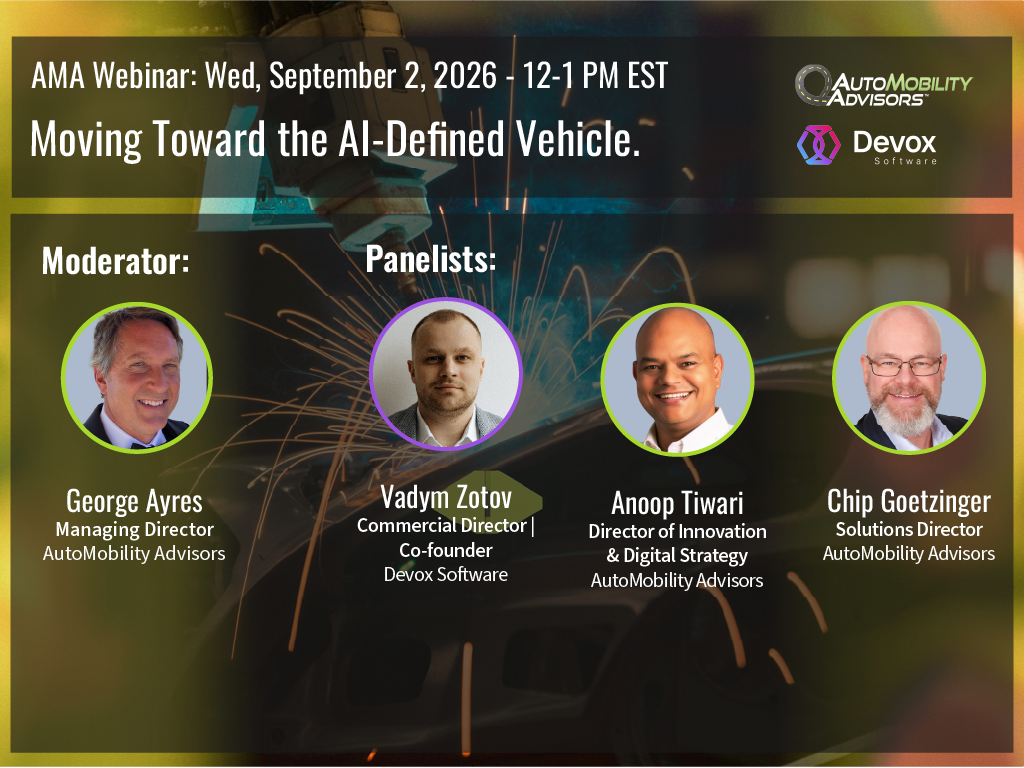
Moving Toward the AI-Defined Vehicle: Webinar Recap
What it takes to deploy AI responsibly across automotive engineering, manufacturing, supply chain, and vehicle programs — from validating vendor claims to building the data, governance, and human oversight that make results measurable.
George Ayres · Sep 2, 2026 Newsletter
Drivers pick the station by what is next door
Paren studied 4,105 DC fast charging stations at 100 kW or above and found the median site running 9 sessions a day, grocery-adjacent sites running 42, and sites with nothing within walking distance running 3. A 100 kW session takes 25 to 40 minutes, which is what a grocery run takes, so the low numbers at most sites measure whether people will wait in a parking lot for half an hour and tell you very little about EV demand in that trade area.
George Ayres · Sep 10, 2026 THOUGHT LEADERSHIP
AI Won't Fix a Broken Foundation
Moving Toward the AI-Defined Vehicle — AMA x Devox Software webinar Chip Goetzinger
- Devox Software
Sep 2026Watch talk
Talk to us about what you want to accomplish
Schedule 20-minutes with AMA. We will use the time to understand what you are trying to accomplish and how AMA can help.