George Ayres at COVESA on the cost of keeping vehicles connected
At the COVESA All Member Meeting in Novi, George Ayres covered the cost of moving data to and from the vehicle, broadcast and onboard AI as cheaper paths, and what light-duty can learn from trucks, golf carts, micromobility, and power sports.
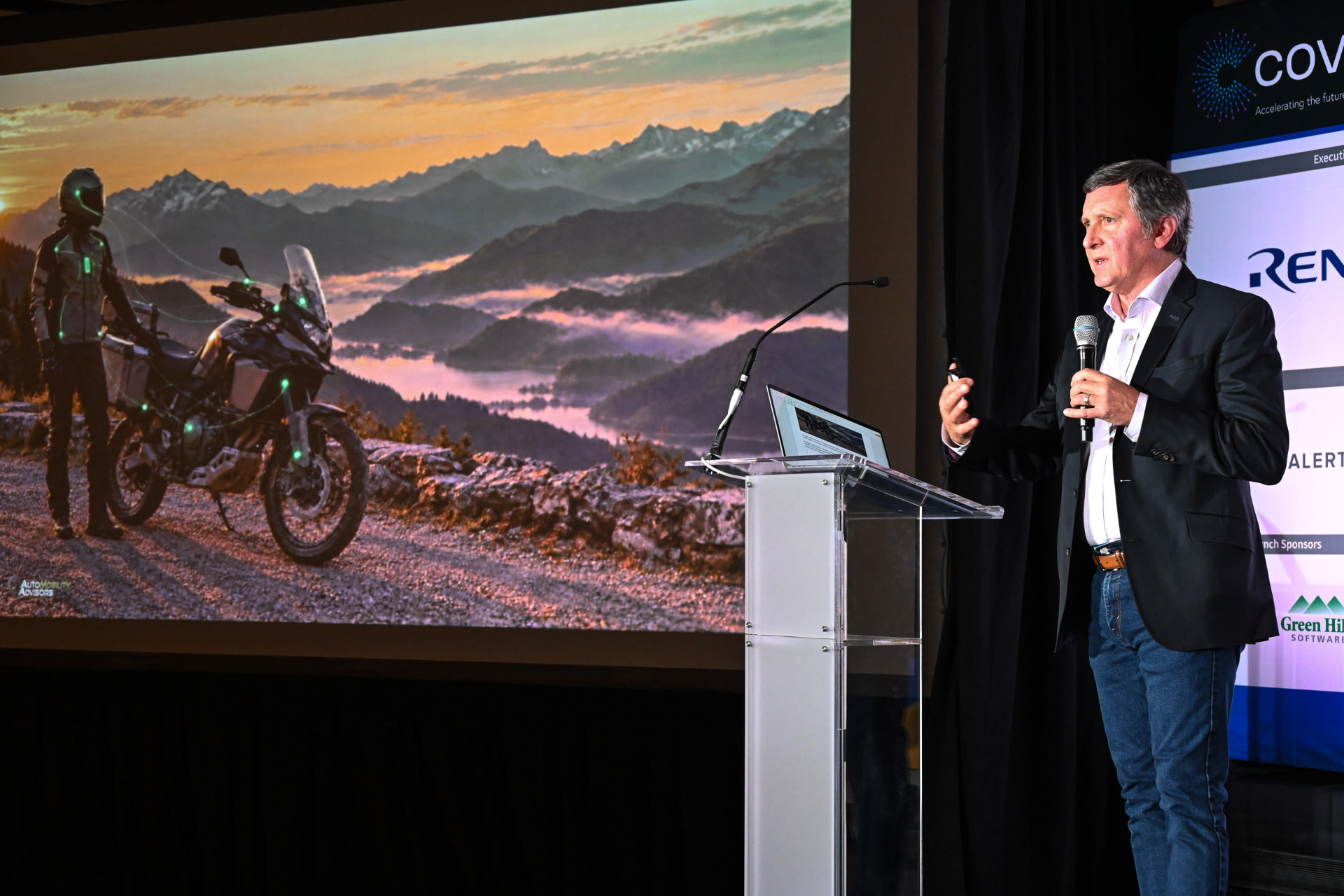
George Ayres, our Managing Director, closed the first day of the COVESA All Member Meeting at the Sheraton Detroit Novi Hotel on October 28 with a session he called the end note, standing between the audience and the expo reception. His talk, "Emerging Trends in Connected Vehicles," covered what the AutoMobility Advisors team has been seeing and working on across connected vehicles, then turned to heavy trucks, low-speed vehicles, micromobility, and power sports to see what the light-duty business can learn from them.
The technology works and the business model is catching up
A single connected vehicle can generate up to 25 gigabytes of data an hour, by the McKinsey figure George cited, and the industry spent years talking about a $750 billion market for vehicle data, a number he said leaders such as GM's Mary Barra used to quote. McKinsey has since revised that estimate down and now counts cost savings in the value alongside revenue, which shows how hard data monetization has been to pin down.
His frame for the rest of the session was that the technology is already in place, and what still has to catch up is the business model and customer acceptance. Drivers resist paying a subscription for a feature they can get free on their phone, and George built the talk around where that gap is closing and who is closing it first.
Software-defined vehicles start with fewer modules
A software-defined vehicle separates hardware from software so each can be updated on its own schedule, and it centralizes compute so a change reaches the whole vehicle faster. George pointed to Ford CEO Jim Farley's 2023 description on the Fully Charged podcast of about 150 modules in a Ford vehicle, each from a different supplier, with software written by 150 different companies in 150 programming languages. A clean-sheet automaker such as Tesla never had to untangle that.
Electronic systems made up about 30 to 35% of a vehicle's bill of materials a few years ago, and George cited a forecast that puts them at 55% by 2030. Zonal and high-performance compute architectures cut that complexity back, and Rivian's second-generation R1T and R1S removed about 1.6 miles of internal wiring and 44 pounds of weight while reducing their ECU count from 17 to 7.
For the owner, George described plugging the car in at night and waking up to the latest maps and features, an experience phone owners already take for granted.
Cellular updates are consuming connected vehicle budgets
At CES in January, an OEM connected vehicle team told George that 85% of its budget goes to pushing over-the-air updates over cellular, which leaves little for new features or new customer experiences. Cellular through AT&T, Verizon, and T-Mobile is the dominant connectivity strategy, and it carries the added cost of sunsetting each generation, from 2G and 3G to today's advanced 5G. Satellite fills the gaps for positioning and emergencies where there is no cellular signal, and it is expensive as well.
Broadcast multicast is the option George said many people in the room hadn't heard of. A television tower sends IP data one to many, to every equipped vehicle in range at once, so an OEM can push map updates continuously and move part of its over-the-air traffic off cellular at a much lower price. By his count there are about 2,000 television towers in the United States against roughly 425,000 cellular towers, and each television tower covers far more ground than a cell site.
The same towers can also carry real-time kinematic correction data, which George said brings GPS accuracy from one to three meters down to about two centimeters. Farmers already use that precision in systems such as John Deere's See & Spray, which pairs cameras with exact positioning to target individual weeds and cut herbicide use, runoff, and cost. On the road, one to three meters is close to the width of a lane, so two-centimeter positioning gives a vehicle a much better chance of staying in it.
More AI is moving into the vehicle
Since every round trip between the data center and the car costs money, George argued that OEMs should do more inside the car itself. Small language models running on zonal and high-performance compute can handle requests locally, and driver monitoring and gesture control give the vehicle more to work with. AMA works with a company whose camera-based AI watches the road ahead and the cabin for driver and occupant monitoring, detecting whether a driver is tired or smoking. Large action models go a step further and carry out tasks in the vehicle on the driver's behalf.
Onboard AI also keeps working where connectivity drops, and George noted that in a parking garage with a weak cellular signal, a broadcast signal often reaches deeper into the structure while a model stored in the vehicle still does what the driver needs.
Vehicle data has to end in action and stay protected
Blink AI, a company AMA works with, carries a signal from the car all the way to a repair. When a check engine light comes on, telematics passes it to Blink AI's system, which connects to the dealer's scheduling tool, such as Xtime or myKaarma, and to the dealer management system behind it. The owner gets a text within moments offering appointment times and books one with a reply, and the technician has the diagnostic information before the car arrives.
George said some dealers using Blink AI have seen service revenue rise 20 to 30%, and the OEM gains satisfaction because more repairs get done. He expects much more vehicle data to be used this way, now that connected vehicle data is turning into actions that someone completes.
A Northeastern University and Consumer Reports study this fall showed why that data needs careful handling, testing 30 companion apps and finding that 28 sent data to at least one outside advertising or analytics company, with several sending identifiers such as VINs and email addresses, and Honda stopped sending location data to one analytics vendor after the findings came out. George also put the number of companies making apps for the auto sector at about 1,119, with 152 of them in the US.
Security now reaches into the vehicle's displays, and George described how a hacked rear camera display could show a clear road behind the driver while a truck closes in, a risk AMA has worked on with a company supporting the Video Electronics Standards Association. Regulation adds after-sale obligations too, starting with the EU battery passport, which becomes mandatory on February 18, 2027 for EV batteries and records battery condition for reuse and recycling.
Trucks, golf carts, micromobility, and power sports have lessons for light-duty
Heavy truck fleets already see the return on connected vehicles. The "Computer on Wheels" report from Roland Berger, COVESA, and Geotab found that the business case for commercial fleets is clear, while consumer services still face business model and customer acceptance hurdles. Large carriers such as J.B. Hunt and Schneider run mixed-brand fleets with their own data science teams, and they keep investing in connected services.
George set Walmart's 2014 concept for the truck of the future beside what is on the road 12 years later. Tesla began high-volume Semi production in Nevada this year with a planned capacity of 50,000 trucks a year, and at IAA Transportation in Hanover in September, BYD brought its ETT 44 electric tractor to Europe, rated for 44 tonnes and up to 372 miles of range, with a 20 to 80% charge in about 20 minutes on megawatt charging.
At the GolfCarting Expo in Charleston this month, George saw about 50 golf cart companies, some selling carts for $35,000. The hundreds of thousands of golf carts in the US get their connected services almost entirely through CarPlay, Android Auto, and phone-linked dashboards, and many of them run on public streets. In Peachtree City, Georgia, near where George lives, the town is laid out so residents can drive a golf cart almost anywhere, and kids drive them to high school.
Google Maps and Apple Maps don't tell those drivers where a golf cart can legally travel, which is the gap our client Cartin' fills with an app that shows the routes and rules, along with a friends radar so neighbors can find each other in real time. In micromobility, George cited figures showing that about 70% of riders use scooters and e-bikes to reach trains and buses, and cities and providers have agreed on a shared data standard for locating those vehicles, the kind of standardized communication the core auto business has been working toward for years.
Riders of motorcycles and off-road vehicles from companies such as Harley-Davidson, Ducati, KTM, and Polaris want tamper alerts, GoPro integration, and after-ride reports, and George said about 30% of Polaris vehicles now carry its RIDE COMMAND+ connected system. Ducati and Dainese link a motorcycle's crash sensors to an airbag jacket so the bike signals the jacket to inflate, and Bosch offers downloadable functions for motorcycles, such as a riding program for a specific racetrack.
Serviceability has to last past the first owner
In his closing, George said every OEM he talks to finds it too expensive to send data to the vehicle and pull data back, so the work now is finding cheaper and more efficient paths. Automakers also have to learn to run a services business, and connected vehicles are where they are learning it, through features on demand, battery passports, and connected services that OEMs now support for 10 years across the second, third, and fourth owner. He also urged the room to watch the wider connected world, from electric heavy trucks to power sports, micromobility, and the low-speed vehicles moving toward embedded telematics.
In the Q&A, an attendee asked how long cybersecurity serviceability will last on connected vehicles. George said automakers rarely plan past the first owner and the dealer network isn't set up to reach later ones, even though regulation will require OEMs to keep supporting a vehicle after the sale. He pointed to Honda reaching millions of owners of 12- and 15-year-old Civics for the Takata airbag recall, and noted that an independent shop can keep a 20-year-old car running mechanically while its software security still has no owner.
I think the cost of moving data and the length of the customer relationship are becoming one problem for OEMs. A vehicle sold today will need security updates through several owners and well past its warranty, and each of those updates travels over a network someone pays for, so the cheaper delivery paths George described matter as much to the services business as they do to the engineering budget.
Go deeper on this topic
Putting vehicle data to work?
More from the AMA team.
 BLOG
From hardware to AI: mapping the software-defined vehicle maturity journey at COVESA
At the COVESA All Member Meeting in Novi, Omdia's Steve Bell and Maite Bezerra and SAE ITC's Tim Yerdon gave the first public look at the seven-level Digital Vehicle Maturity Level framework.
Mariestella Colón Astacio · Oct 30, 2026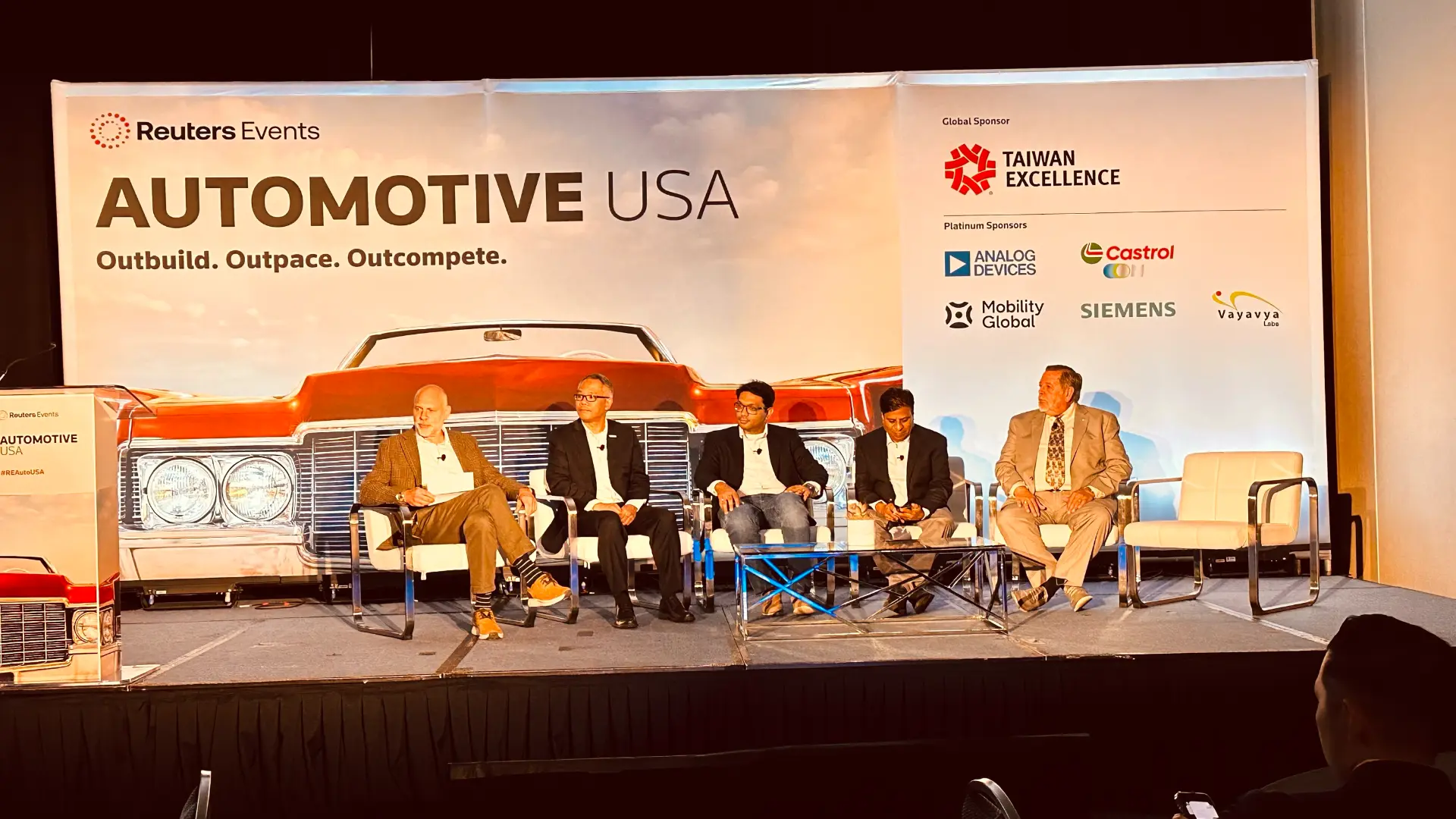 BLOG
Allen Levenson moderates the SDV foundation panel at Reuters Automotive USA 2026
At Reuters Events: Automotive USA in Detroit, Allen Levenson moderated “Accelerate to Market: Building the SDV Foundation Without Losing Speed” with leaders from Karma, GM, Scout Motors, Vayavya Labs, and Sinclair's ONE Media.
Mariestella Colón Astacio · Oct 28, 2026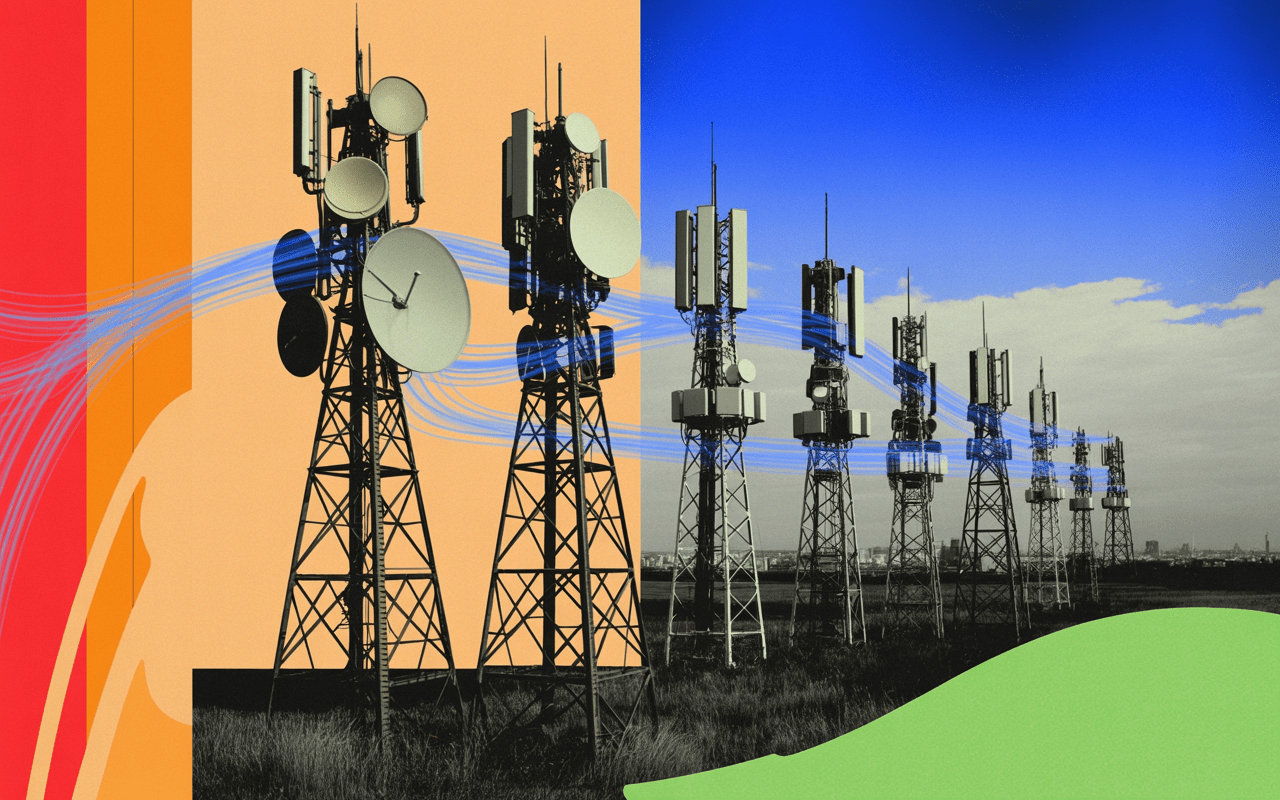 BLOG
ATSC 3.0 Standards: Spring 2026 Momentum in Broadcasting
Understanding the technical blueprint behind next-generation television. Spring 2026 is bringing real momentum to the next-generation broadcasting landscape, with ATSC 3.0 moving from standards documents into market deployments.
Mariestella Colón Astacio · Mar 26, 2026
Talk to us about what you want to accomplish
Schedule 20-minutes with AMA. We will use the time to understand what you are trying to accomplish and how AMA can help.